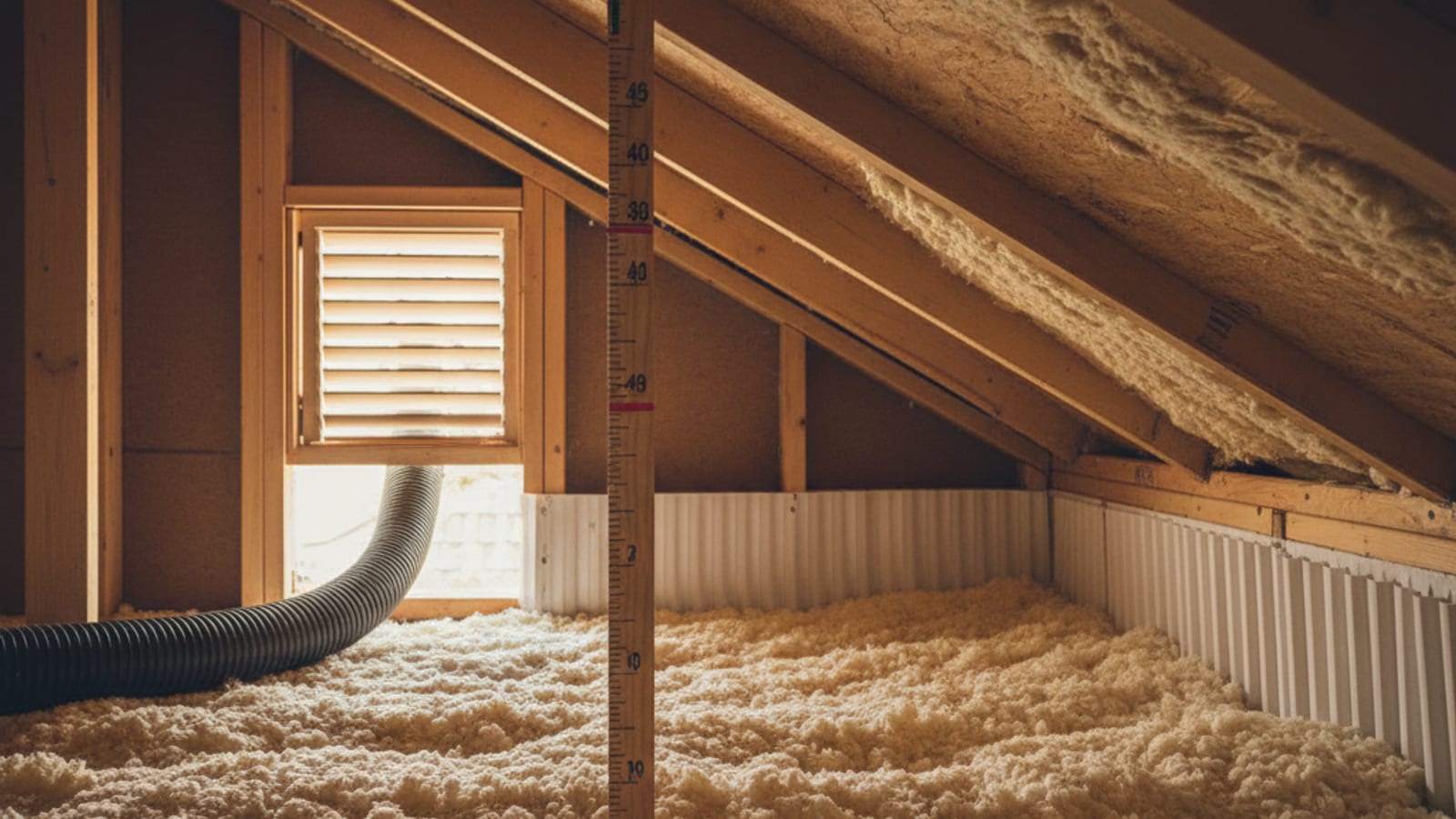
R-value is the resistance to heat flow through a material. Higher number, more resistance, less heat moving through. It’s a per-inch property — so 1 inch of fiberglass is R-3.7, 12 inches is R-44.
That’s the technical answer. Here’s what it actually means for your San Diego home.
The short version
- Attic floor (vented attic): target R-49. Code minimum is R-30 to R-38; R-49 is the sweet spot.
- Roof deck (unvented attic, cathedral ceiling): target R-30 to R-38, depending on assembly.
- Walls (2x4 framing): R-13 to R-15. (2x6 framing: R-19 to R-21.)
- Floors over crawlspace: R-19 minimum.
- Crawlspace walls (encapsulated): R-10 to R-15 continuous.
Those are the targets we hit on most San Diego retrofits unless something specific calls for higher.
What Title 24 requires
California’s Title 24 building code sets minimums based on climate zone. Most of San Diego County falls in two zones:
- Climate Zone 7 (most of the coastal and central county): R-30 attic minimum on a roof alteration, R-13 walls (2x4), R-19 floors over crawl.
- Climate Zone 10 (inland — Escondido, El Cajon, Santee, etc.): R-38 attic minimum on a roof alteration, R-13 walls (2x4), R-19 floors over crawl.
A few things to note about Title 24:
The minimums are minimums. They’re the floor, not the goal. We usually exceed them by 10–30 percent because the marginal cost is small and the comfort difference is real.
Title 24 only kicks in on alteration permits — re-roofs, additions, full remodels. A no-permit insulation top-up doesn’t trigger code, but we still hit code-level R-value because anything less is leaving money on the table.
The faced product matters in some assemblies. Faced batts (kraft paper or foil) provide a vapor retarder. Title 24 calls for them in specific cold-side wall assemblies. Most San Diego retrofits don’t need them.
R-value isn’t the only number that matters
Two assemblies with the same R-value can perform very differently. The reason is air movement. Insulation slows heat by trapping still air. Moving air bypasses insulation completely.
A wall with R-13 batts and a 1-inch gap around an electrical box is performing more like R-7 in real life. A wall with R-13 batts and zero air leaks is performing close to R-13.
This is why we air-seal before we insulate. Caulking top plates, foaming chase penetrations, gasketing the attic hatch, and replacing leaky recessed lights — that work doubles the effective R-value of whatever insulation goes in next.
R-value diminishing returns
Going from R-19 to R-30 cuts heat flow roughly 35 percent. Going from R-30 to R-38 cuts another 12 percent. Going from R-38 to R-49 cuts another 7 percent. Going from R-49 to R-60 cuts another 4 percent.
Each step costs about the same. The first step is the highest-return move. By the time you’re going from R-49 to R-60, the marginal return is thin enough that we usually steer that budget into air-sealing or radiant barrier instead.
What ‘R-value per inch’ means for thickness
Different products give different R per inch. Same R-49 attic:
- Open-cell spray foam (R-3.7/in): 13.5 inches.
- Fiberglass batt (R-3.2/in): 15.5 inches.
- Loose-fill cellulose (R-3.7/in): 13.5 inches.
- Loose-fill fiberglass (R-2.5/in): 19.5 inches.
- Closed-cell spray foam (R-6.5/in): 7.5 inches.
Inches matter when your attic has limited depth. A truss attic with 10 inches of clearance can’t hit R-49 with loose-fill fiberglass — you’d compress it against the deck and lose the R you paid for. We pick the product to match the depth available.
What the LTTR is
For polyiso rigid foam boards, R-value is sometimes reported as LTTR — long-term thermal resistance. Polyiso starts at higher R-value when new, then drops slightly over the first 6 months as the blowing agent gases out. LTTR accounts for that. Always use the LTTR number when comparing rigid foams.
What ‘whole-wall R-value’ is
The R-value on the bag is for the cavity insulation. The actual wall has studs every 16 inches, and each stud is roughly R-5. That brings the whole-wall R-value down 10–20 percent below the cavity R-value.
Continuous insulation (rigid foam on the exterior) defeats the stud thermal bridge. It’s why exterior continuous insulation is now standard on high-performance new builds.
The bottom line for San Diego
For most homes, the right targets are: R-49 attic, R-13 walls (2x4) or R-19 (2x6), R-19 floor over crawlspace, plus aggressive air-sealing. Hit those numbers with the right product for the assembly, and you’ll see a comfort and energy difference you can feel without an instrument.