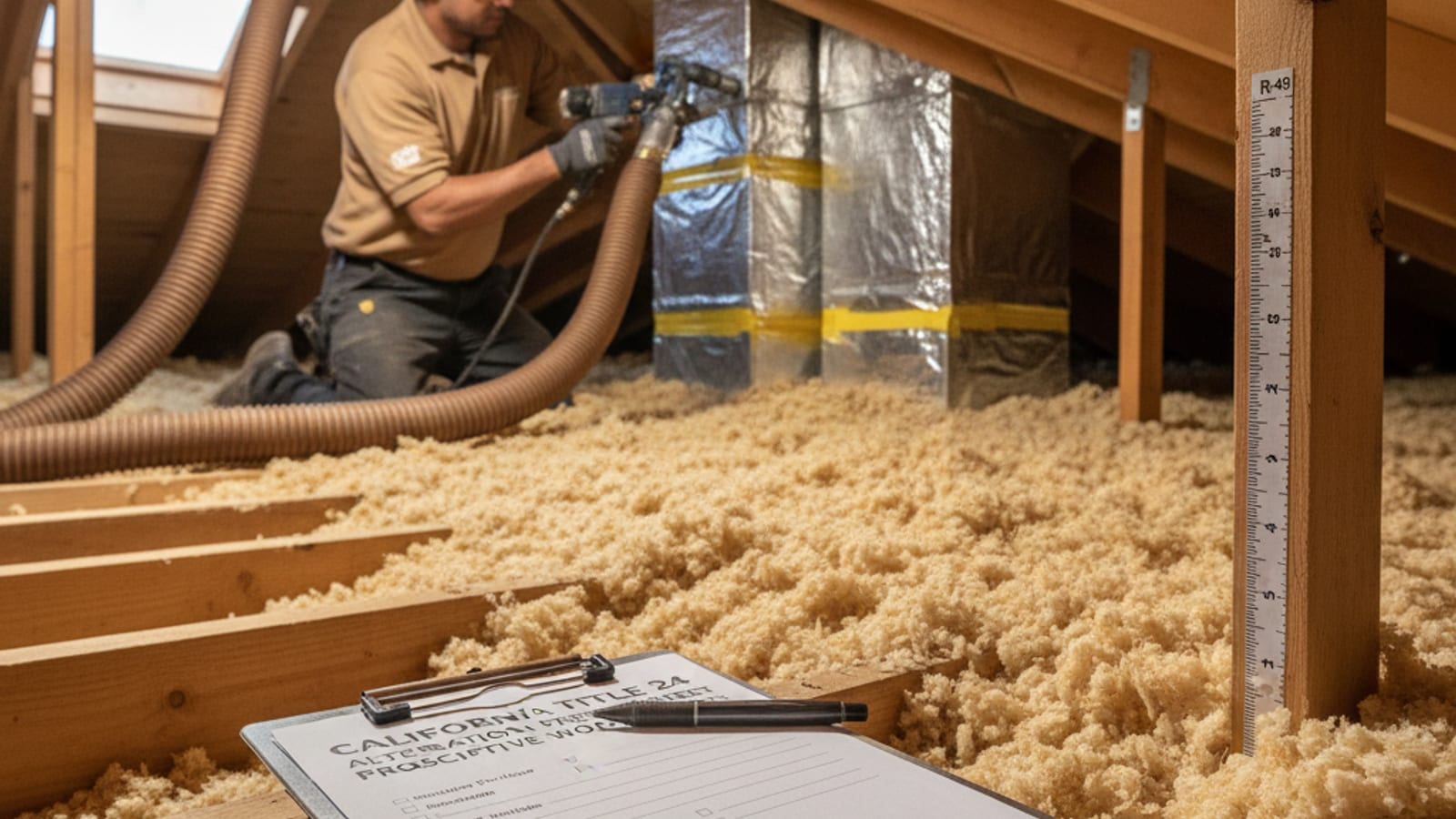
California’s Title 24 sets the minimum insulation R-values your home must meet on a permitted alteration. Most San Diego homes fall into two climate zones — and the rules are different for each. Here’s what applies to you.
San Diego County climate zones
- Climate Zone 7: Coastal and central San Diego. Most of the western half of the county — Coronado, Imperial Beach, San Diego, La Mesa, Encinitas, Carlsbad, Oceanside.
- Climate Zone 10: Inland San Diego. Escondido, San Marcos, Vista, Poway, El Cajon, Santee, Lakeside, Alpine, plus most backcountry communities.
The dividing line runs roughly along Interstate 15 and the El Cajon/Lakeside boundary. CZ10 is slightly stricter on insulation minimums because it sees real summer heat.
Title 24 minimums (alteration / addition)
These are the minimums when you pull a permit for an alteration, addition, or remodel. New construction is held to higher whole-house performance standards.
Attic floor (vented attic)
- CZ7: R-30 minimum
- CZ10: R-38 minimum
We recommend R-49 in both zones — the marginal cost above R-38 is small and the comfort difference is real, especially in CZ10.
Roof deck (unvented attic, conditioned attic conversion)
- CZ7: R-30 minimum at the roof deck (closed-cell spray foam typical)
- CZ10: R-38 minimum at the roof deck
Walls (2x4 framing)
- CZ7: R-13 minimum
- CZ10: R-15 minimum (or R-13 + R-3 continuous insulation)
Walls (2x6 framing)
- CZ7: R-19 to R-21
- CZ10: R-19 to R-21
Floors over crawlspace
- CZ7: R-19 minimum
- CZ10: R-19 minimum (R-30 better for inland comfort)
Slab edge (heated slab)
- Both zones: R-7 minimum at slab perimeter, 16 inches deep or to footing.
When Title 24 actually kicks in
The minimums only apply when you pull a permit for one of these:
- Alteration permit (re-roofing, addition, room conversion, ADU build, garage conversion).
- Major remodel that touches insulation (new walls, opened-up ceilings).
- HVAC permit that involves changing the thermal envelope.
Voluntary insulation upgrades — topping up an attic without changing anything else — don’t trigger Title 24. But we still hit code-level R-value because anything less leaves comfort and energy savings on the table.
The two compliance paths
Title 24 lets builders pick one:
Prescriptive path. Each component (attic, walls, windows, etc.) meets a specific minimum. Simpler, no testing required. Most retrofits use this path.
Performance path. A whole-house energy model run by a HERS rater shows the home meets a target site energy use. Lets you trade off — better windows in exchange for lower wall R-value, for example. More flexible but requires HERS testing.
For most insulation-only retrofits, prescriptive is the right path. We document the work, photo the depth markers, and the inspector signs off.
Where the rules tighten in 2026 and 2028
Title 24 updates every three years. The 2025 cycle (effective January 2026) raised attic minimums and added more aggressive air-sealing requirements. The 2028 cycle is expected to push CZ10 attic minimums to R-49 and require continuous insulation on more wall assemblies.
If you’re insulating now, we recommend hitting the next-cycle target rather than today’s minimum. The marginal cost is small and you future-proof against the next sale or refinance.
Common Title 24 mistakes
A few things that fail plan check or inspection:
- Compressing batts to fit between studs that have wires or boxes. Compressed insulation loses R-value at the spot you need it most.
- Skipping baffles at eaves. Required to keep soffit vents clear of blown-in insulation.
- Wrong vapor retarder placement. In CZ10 some assemblies require a faced batt with the kraft paper on the warm side. Get this wrong and the inspector calls it.
- Insulating around a non-IC-rated recessed light. Old non-IC cans must be replaced or covered with airtight enclosures before insulating.
- No depth markers on rafters for blown-in. Required for inspection. We mark them on every job.
What we document for plan check
For any permitted insulation scope, we provide:
- Material certificates (R-value, density, fire rating, manufacturer, batch).
- Installer certification (CSLB C-2 license).
- Depth verification photos.
- Title 24 worksheet showing prescriptive compliance per component.
- HERS verification (if performance path or whole-home test required).
That packet goes to the plan reviewer with your permit. We’ve never had one come back rejected when we own the insulation scope.
The bottom line
If you’re pulling a permit, Title 24 compliance is non-negotiable. We know the rules for both San Diego climate zones, document the work to inspector standard, and produce the paperwork your plan reviewer needs.
If you’re not pulling a permit but want to upgrade voluntarily — we still recommend hitting Title 24 minimums or above. The energy and comfort math says yes either way.
Free in-home estimate gets you the spec for your specific home and zone.