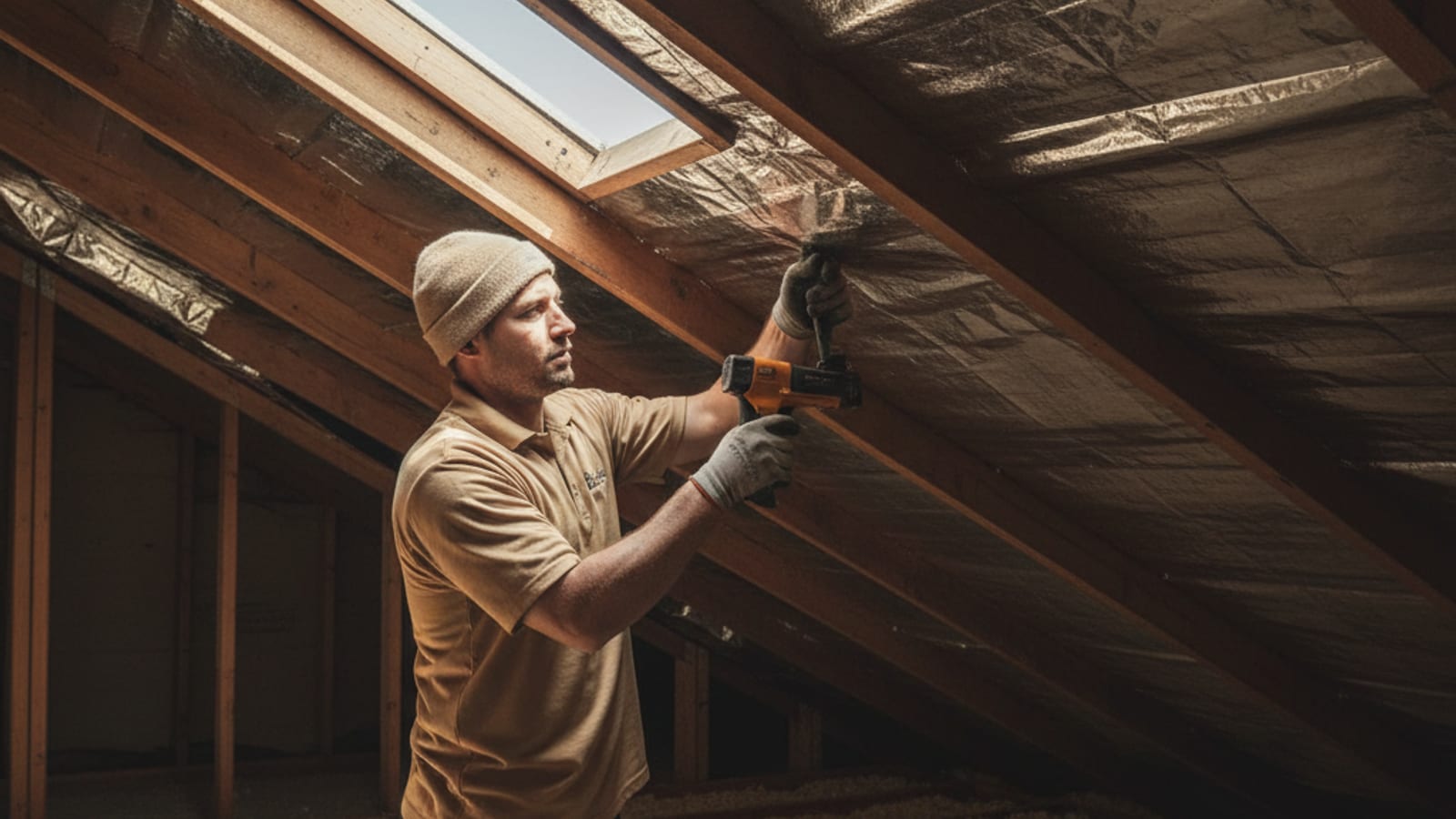
Radiant barrier is one of the most oversold insulation upgrades in California — and one of the most under-installed in the places it actually matters. East County San Diego is firmly in the “actually matters” category. Here’s why, and when it pays back.
What a radiant barrier does
Most insulation slows conductive heat — heat that moves through a material by direct contact. R-value measures conduction resistance.
Radiant barriers don’t add R-value. They reflect infrared radiation — heat moving through space as electromagnetic energy. The sun heats your roof to 150–170°F on a hot day. The hot roof radiates infrared down into the attic. Anything in the attic — including HVAC ducts, the insulation on the floor, and the air itself — absorbs that infrared and heats up.
A foil radiant barrier on the underside of the rafters reflects 90 to 97 percent of that infrared back through the deck. The attic stays cooler. The HVAC system works less. The ducts deliver cooler air.
When it pays back
Radiant barrier is worth it when three things are true:
- Hot attic. Inland and East County summer attic temps push 140–160°F. That’s where radiant heat is dominant.
- HVAC ducts in the attic. Those ducts gain heat from the radiant attic. Cooling them costs money.
- South-facing or low-shade roof. Northern exposure or heavy tree cover means less direct sun load — less radiant component to barrier against.
In El Cajon, Santee, Lakeside, and Alpine — the hottest zones in the county — all three are usually true. We see attic temps drop 20–30°F after a radiant barrier install. AC bills typically drop 5–15 percent during peak summer.
When it doesn’t
Radiant barrier underperforms in three scenarios:
Coastal homes. Coastal attics rarely exceed 110°F. The radiant component is small. We usually skip radiant barrier on Coronado, Del Mar, Imperial Beach, and Encinitas homes and put the budget into air-sealing instead.
No ducts in the attic. If your HVAC ducts run in conditioned space (basement, finished crawl, between floors), the attic temperature matters less. The radiant barrier still helps, but the payback is thinner.
Homes already at R-49+ with sealed ducts. Once the attic floor is well-insulated and the ducts are sealed, the radiant attic doesn’t reach the conditioned space below. Adding radiant barrier on top is diminishing returns.
What it costs
Two installation methods:
Staple-up retrofit. We staple foil radiant barrier to the underside of the rafters. Works on any existing roof. Runs $0.50 to $1.20 per sq ft of attic floor — typically $750 to $1,800 for a 1,500 sq ft attic.
Reflective deck on a reroof. New plywood with a foil-faced sheathing replaces the existing deck. Best efficiency because the foil sits right against the underside of the deck with no air gap — but only practical during a reroof. Costs $1 to $2 per sq ft above standard deck cost.
For most homeowners, staple-up retrofit is the right move. You don’t have to wait for a reroof, and the performance difference is small.
The combination that actually works
Radiant barrier alone is rarely the highest-return move. Radiant barrier combined with proper air-sealing and R-49 attic insulation is one of the best East County upgrades available.
Standard scope for an El Cajon or Santee home: air-seal first (top plates, can lights, attic hatch — about $600), R-49 cellulose blown-in (about $3,000), radiant barrier on the rafters (about $1,500). All three together: roughly $5,000–$5,500 for a typical 1,500–1,800 sq ft attic.
Result: attic temps drop 25–35°F at peak. Cooling load drops 20–30 percent. The AC catches up faster on hot afternoons. Upstairs rooms that used to lag the thermostat by 5–8 degrees stay closer to set point.
Common myths
Radiant barrier replaces insulation. False. They do different jobs. Insulation handles conduction. Radiant barrier handles radiation. Each does its own thing.
Radiant barrier always cuts AC bills 25 percent. False. Some installs do. Most are in the 5–15 percent range. The 25 percent claim usually comes from the worst-performing baseline (uninsulated attic, dark roof, full sun).
Radiant barrier blocks heat from leaving in winter. Theoretically. Practically, San Diego winters don’t have enough heat-from-attic-to-room transfer for this to matter much. Don’t pay extra for a winter benefit you’ll never measure.
Foil that’s spray-on-the-roof works the same. False. Foil-faced sheathing or proper foil with an air gap on the rafter side works because radiation requires a temperature differential across an air gap. Spray-on coatings on the underside of the deck without an air gap perform much worse.
Who benefits most
If you live in El Cajon, Santee, Lakeside, Alpine, Spring Valley, Jamul, or anywhere else in East County, your attic gets hot enough that radiant barrier earns its keep. Same goes for hot inland Escondido, San Marcos, and Vista neighborhoods.
If you live coastal, north coastal, or central San Diego, radiant barrier is usually a lower-priority upgrade. The same dollars go further into air-sealing or attic insulation top-up.
We tell you which case you’re in on the first visit. Free in-home estimate, honest answer either way.