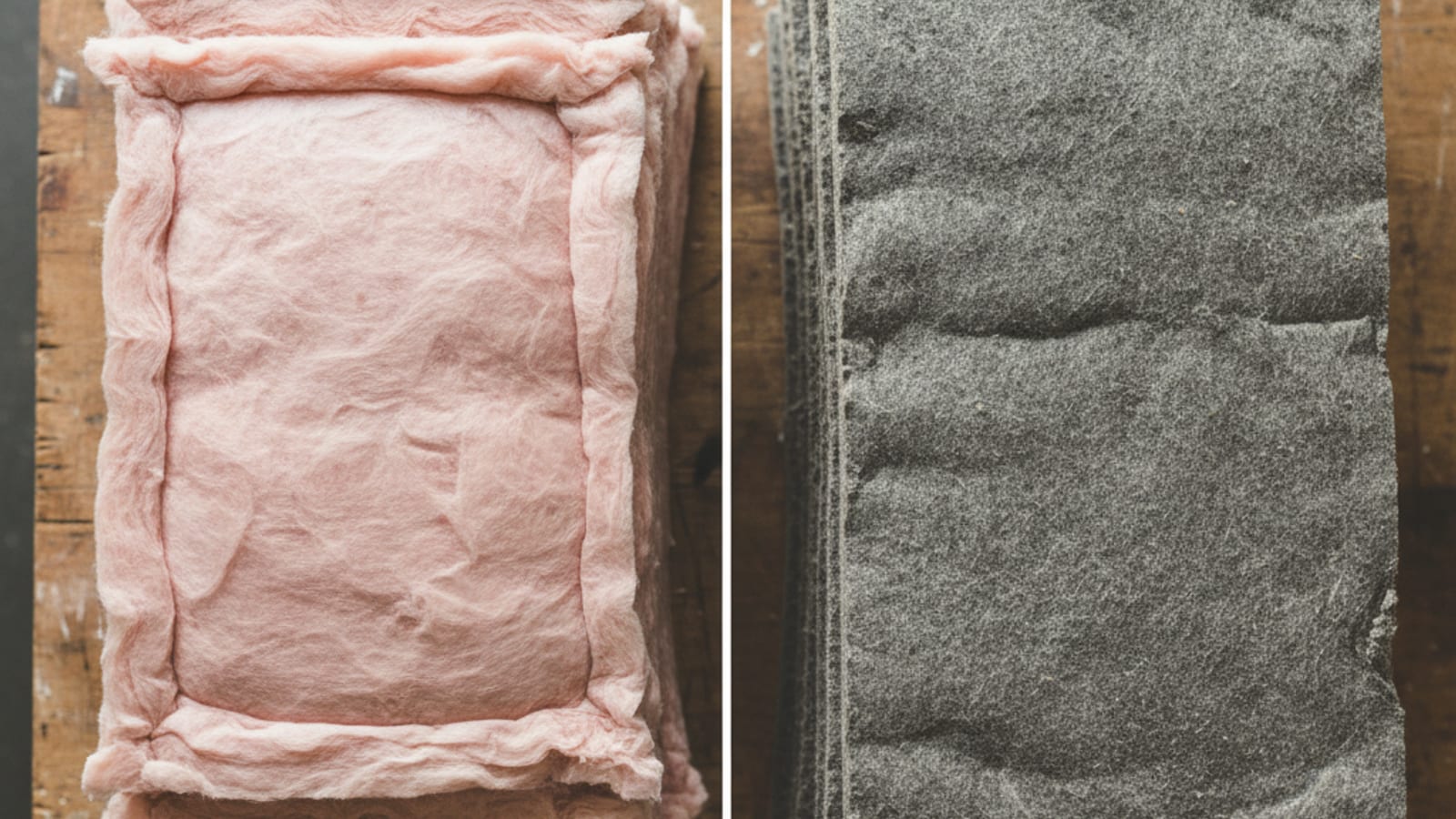
Mineral wool and fiberglass batts both fit in stud bays, both add R-value, and both look similar at first glance. Their differences show up where the assembly gets demanding — fire, sound, moisture, exterior exposure. Here’s where each one wins.
The short version
- Fiberglass batts: cheaper, lighter, easier to handle. R-3.2 to R-4 per inch. Right for most interior walls, ceilings, and floors.
- Mineral wool batts: denser, fire-rated, sound-better, water-resistant. R-3.7 to R-4.3 per inch. Right for exterior walls in high-fire zones, sound walls, fire-rated assemblies, and any cavity that might see moisture.
If you’re framing a typical interior wall in a typical addition, fiberglass is fine. If you’re framing an exterior wall in Julian, a sound wall in a home office, or a fire-rated demising wall in an ADU, mineral wool earns its premium.
R-value head-to-head
| Product | R per inch | R-value at 3.5” | R-value at 5.5” |
|---|---|---|---|
| Standard fiberglass batt (R-13) | 3.7 | R-13 | R-21 |
| High-density fiberglass batt (R-15) | 4.3 | R-15 | R-23 |
| Standard mineral wool batt (R-15) | 4.3 | R-15 | R-23 |
| High-density mineral wool batt (R-23) | 4.2 | R-15 | R-23 |
R per inch is roughly the same. The difference shows up in non-R characteristics.
Fire performance
Mineral wool is the clear winner here. It’s spun from molten stone or slag and doesn’t burn. Standard mineral wool batt holds together at 1,800°F+. Fiberglass starts losing structural integrity around 500°F and the binder volatilizes earlier.
In high-fire-risk zones (Julian, Pine Valley, parts of Ramona, San Diego County’s Wildland-Urban Interface zones), mineral wool on the exterior side of the wall assembly adds genuine resistance to ember intrusion through wall cavities.
For fire-rated wall assemblies (ADU demising walls, garage-to-house walls, multi-family separations), mineral wool is often what makes the assembly meet the rating. The UL listing depends on it.
Sound performance
Mineral wool’s higher density (about 2.5x fiberglass) means it absorbs more mid-range sound. Real-world: mineral wool walls run STC 4 to 6 points higher than fiberglass walls of the same thickness, all else equal.
Where this matters:
- Home offices on busy streets
- Music or recording rooms
- Bedroom walls in ADU rentals
- Theaters and media rooms
- Shared walls between living and working spaces
Where it doesn’t:
- Standard interior walls between bedrooms in a single-family home
- Closet walls
- Walls between rooms with similar use patterns
If sound is a goal, mineral wool plus sealed penetrations plus a door gasket gets you most of the way to a real acoustic improvement. Doubling the drywall layer with damping compound between adds another 4 to 6 STC points beyond that.
Moisture handling
Fiberglass loses R-value when it gets wet and dries slowly. Mineral wool is hydrophobic — water beads up and runs off rather than absorbing. Mineral wool also doesn’t support mold growth even if it gets wet.
This matters in:
- Basement walls (rare in San Diego but they exist)
- Crawlspace exterior assemblies
- Exterior wall assemblies where wind-driven rain might intrude
- Any assembly downstream of a known moisture source
For typical interior walls in a dry-climate San Diego home, this isn’t a deciding factor. For exterior walls in coastal homes or backcountry homes that see real winter precipitation, it nudges the math toward mineral wool.
Cost comparison
Pricing per square foot of installed batt (open framing, 2x4 wall):
- Standard fiberglass R-13: $0.90–$1.40 per sq ft
- High-density fiberglass R-15: $1.10–$1.60 per sq ft
- Standard mineral wool R-15: $1.50–$2.20 per sq ft
- High-density mineral wool R-23 (in 2x6): $1.80–$2.60 per sq ft
Mineral wool typically costs 50 to 80 percent more than equivalent fiberglass. On a 1,500 sq ft of wall area, that’s the difference between $1,500 and $2,400 in materials and labor — meaningful but not deal-breaking on most jobs.
Installation differences
Both fit in standard stud bays. Both cut with a sharp blade. Mineral wool is denser and stays where you put it without staples or supports — it’s friction-fit. Fiberglass batts often need stapling or insulation supports to stay tight against the framing.
Mineral wool is itchier to handle than modern fiberglass. PPE matters for both, but more so for mineral wool — long sleeves, gloves, dust mask are essential.
Mineral wool produces more dust during cutting. We work outside or with a vacuum-attached saw when possible.
Health and safety
Both products are safe in finished assemblies. The differences are in handling:
Fiberglass: mild skin irritation on contact, dust irritation during install. Modern formaldehyde-free binders are standard. Material is non-organic and doesn’t off-gas.
Mineral wool: more abrasive on skin during install, dustier during cutting. Like fiberglass, no off-gassing concerns once installed.
We use respirators, gloves, and long sleeves on every batt install regardless of product.
What we recommend
Default to fiberglass for interior walls and ceilings in standard residential framing. Use mineral wool when:
- The wall is exterior and you’re in a high-fire zone
- The assembly requires a fire rating (UL listing) for code
- Sound performance is a real goal
- The cavity might see moisture
- The building owner specifically wants mineral wool for any of the above reasons
We carry both on the truck and pick the one that fits the assembly. Most jobs end up mixed — fiberglass on interior partitions, mineral wool on exterior walls and shared assemblies. Free in-home estimate gets you the right spec for your specific build.