Most homes built in San Diego before 1980 have empty exterior walls. No batts, no foam, just air, framing, and drywall on one side and stucco or siding on the other. That’s a lot of heat moving in and out through nothing.
Dense-pack cellulose fixes it without ripping drywall.
How dense-pack works
Cellulose is recycled paper treated for fire and pest resistance. When it’s blown into open framing as loose-fill, it lays down at about 1.5 lb per cubic foot — fine for attics, where gravity doesn’t matter much.
When it’s blown into a closed wall cavity at high pressure through a hose, it packs to 3.5 lb per cubic foot. That density does three things at once:
- Stops settling. Loose-fill in walls settles 20 percent over time. Dense-pack at 3.5 lb does not settle.
- Stops air movement. The high density resists air migration through the cavity.
- Adds R-value. R-13 to R-15 in a 2x4 wall, R-19 to R-21 in a 2x6 wall.
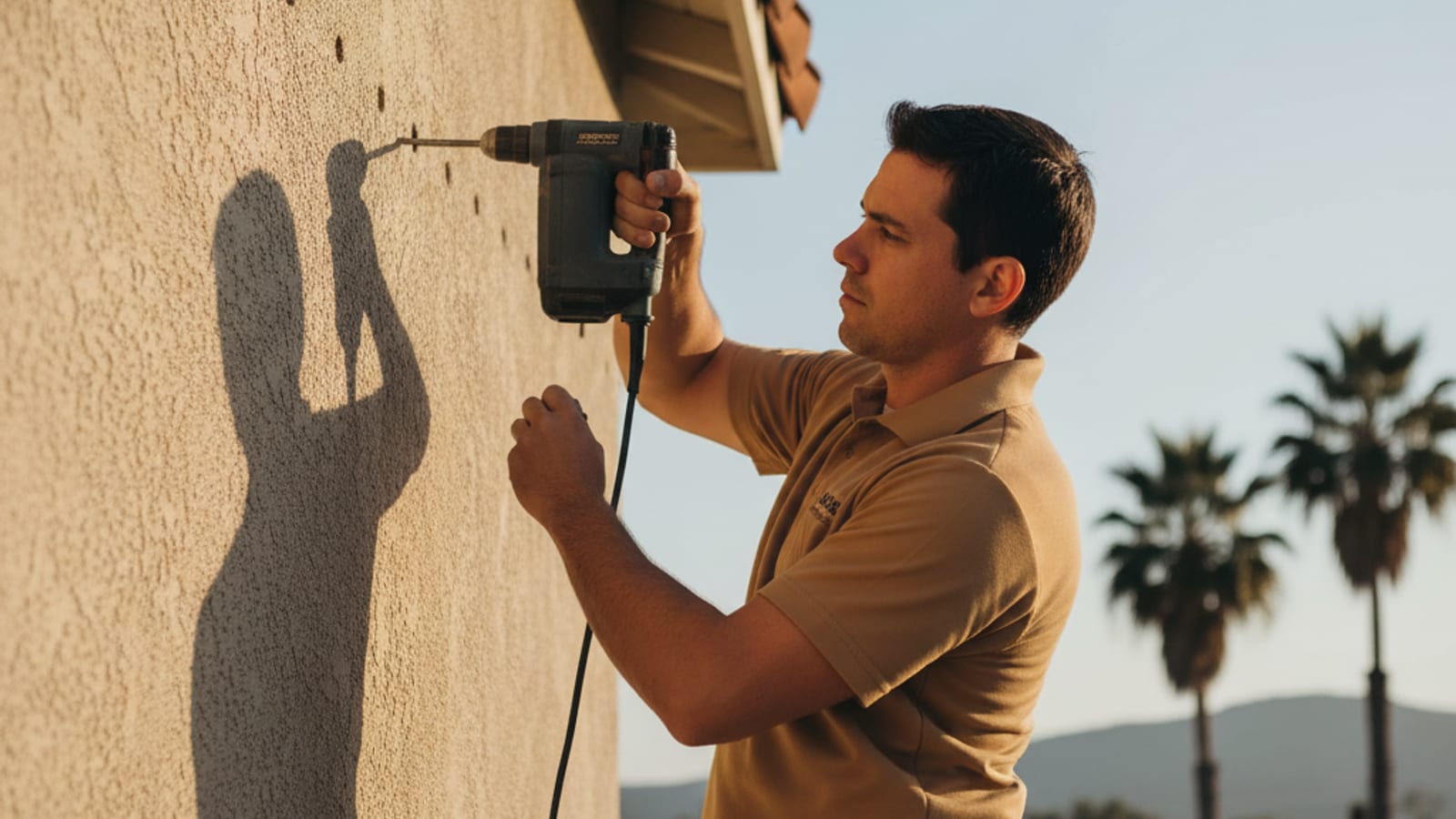
We drill two small holes per stud bay — usually one near the top and one in the middle — feed a fill tube down to the bottom, and pull back as the bay fills to density. The holes get patched and textured before paint.
When dense-pack is the right move
Empty walls. Pre-1980 homes in California rarely have wall insulation. If you can put your hand on the exterior wall in winter and feel cold, or in summer and feel hot, the wall is empty. Dense-pack fills it.
Stucco re-do. If you’re already pulling stucco off for a re-stucco project, drill from the exterior, fill, and re-stucco. Same labor, much less interior disruption.
Sound between rooms. Interior walls between bedrooms, between a bedroom and a media room, or between living spaces and a noisy garage benefit from dense-pack. The cellulose dampens mid-range sound noticeably.
When something else is better
Open framing. If the walls are already opened up — new construction, addition, gut remodel — batts or open-cell foam are faster and cheaper than dense-pack.
Walls with damage. Existing walls with water damage, mold, or termite issues need to be opened up and addressed first. Dense-pack on top of a damaged wall hides the problem.
Walls with old cellulose or batts already. Dense-pack into a wall that already has old loose-fill or batts is messy and unpredictable. Better to remove and refill, or just leave the existing material in place.
What it costs
Dense-pack runs $3 to $5 per square foot of wall area, including patching the drill holes. A typical 1,500 sq ft single-story home has about 1,200 sq ft of exterior wall area — call it $4,500 to $6,500 for the walls. A two-story home with 2,400 sq ft of exterior wall area runs $7,500 to $12,000.
That’s significant money. The payback math depends on your zone:
- East County and inland: 4 to 7 years on cooling savings alone. Faster if you also heat in winter.
- Coastal and central: 7 to 12 years. Slower because heating and cooling loads are smaller.
The non-energy benefits — comfort, sound, resale value — add up but are harder to quantify.
The interior vs. exterior choice
We can drill from the inside or the outside. Each has tradeoffs:
Interior drilling. Two holes per stud bay through drywall, patched and textured to match. Best for homes with stucco that’s hard to patch invisibly. Drywall patches are easier to make invisible than stucco patches.
Exterior drilling. Two holes per stud bay through stucco or siding, patched with stucco patch and color-matched. Best when you’re already painting the exterior, or when interior finishes are too sensitive to disturb.
Either method takes 1–2 days for a typical home. We pick based on which finish is easier to restore in your specific case.
What gets covered
Dense-pack reaches every part of a typical wall cavity:
- Standard stud bays — full fill, top to bottom.
- Headers over windows and doors — separate fill from above each header.
- Corners — diagonal fill tube reaches into the corner.
- Around outlet boxes — fill works around the box; we don’t need to remove anything.
What it doesn’t reach:
- Walls with diagonal bracing (older homes with let-in 1x4 bracing) — we work around the bracing but coverage isn’t perfect.
- Cavities with extensive piping or wiring — we adjust technique but density may be lower in those bays.
- Balloon-framed walls (very old construction without floor-line fire blocking) — these need fire blocks installed first, then dense-packed in sections.
We inspect for these conditions on the first visit and adjust the quote accordingly.
What you’ll feel after
Three differences in the first month after a proper dense-pack:
Exterior walls feel less cold (or less hot). Touch an exterior wall in winter — if it was cold before, it’ll be closer to room temperature after. Same in summer for the hot side.
Sound from outside drops. Traffic noise, dog barks, neighbor conversations all drop noticeably. The dense-pack works as a sound dampener at the same time it works as insulation.
HVAC runs less. Same comfort, less cycling. Bills drop measurably in the first heating or cooling season after install.
The honest version
Dense-pack walls is one of the higher-return retrofit moves on an older home — when the home actually has empty walls. If your home was built after about 1985, the walls probably have something in them already. Don’t pay for dense-pack until you confirm the walls are empty.
We confirm with an infrared scan or by removing one outlet cover and looking inside. Free in-home estimate gives you a real answer before any commitment.