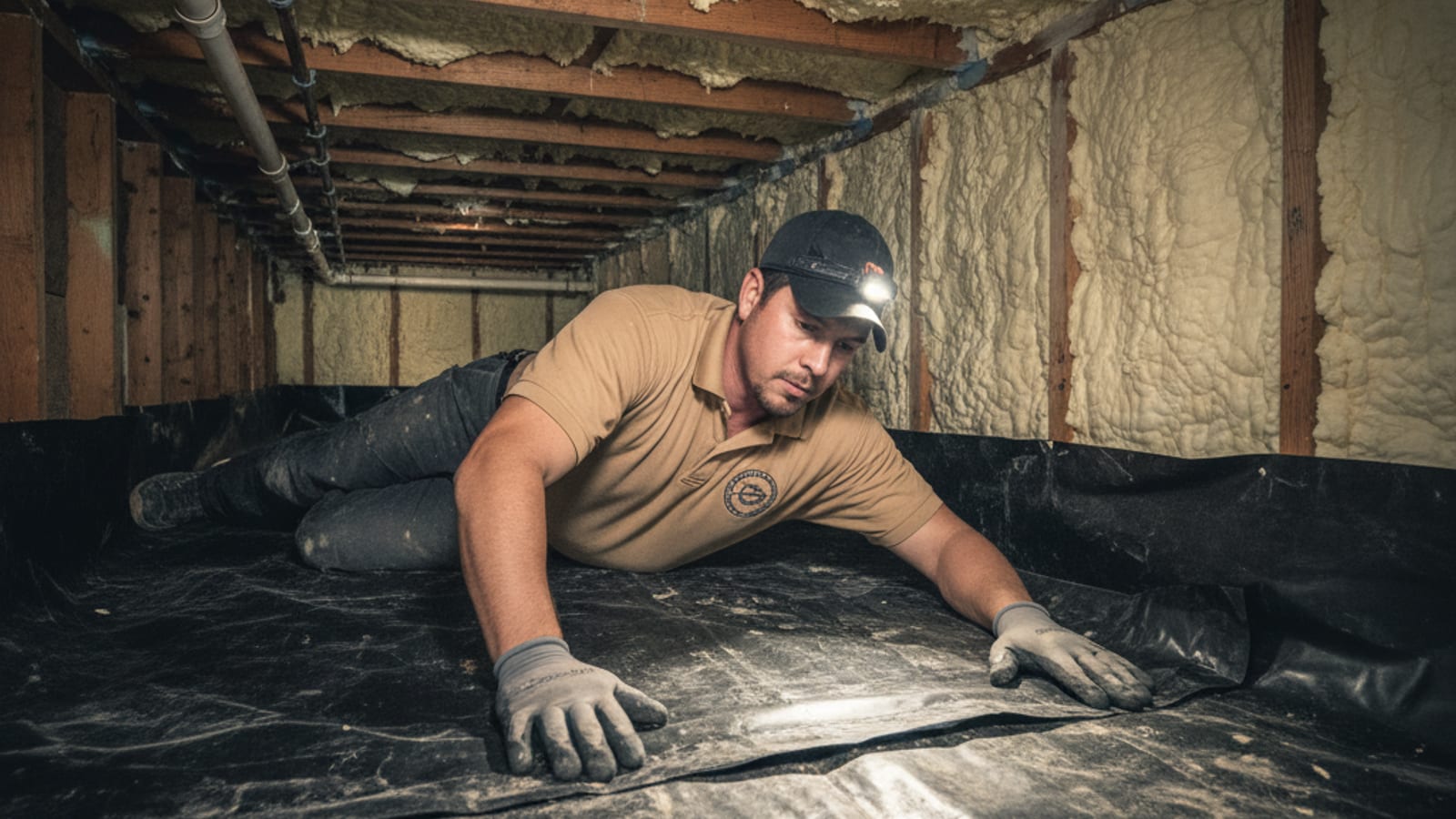
A vented crawlspace is the cheapest part of your home to lose heat through. Cold floors, musty smells from floor vents, and high heating bills usually trace back to the same place: an unsealed, uninsulated, slightly damp space under the house that the previous insulation contractor either ignored or did badly.
Here’s what proper crawlspace work looks like in San Diego.
The three problems
A typical underperforming crawlspace has three issues working against it at once:
Moisture from the dirt floor. Bare earth wicks moisture upward year-round. In San Diego that’s slow but constant — and it migrates into the wood framing above, into any insulation in the joists, and through the floor into the conditioned space.
Air leakage at the rim joists. The rim joist is where the floor framing sits on top of the foundation. There’s usually a gap between the framing and the foundation, and another gap between the framing and the subfloor. Both let outdoor air directly into the conditioned space.
Subfloor heat loss. Cold air in the crawlspace conducts heat right out of the floor above. Even a properly insulated subfloor performs poorly if the crawlspace itself is 55°F.
The standard fix
For most San Diego homes — coastal humidity included — the right scope is:
-
Vapor barrier on the dirt floor. 10 to 20 mil polyethylene, taped at seams, run up the foundation walls 6 inches, and sealed at the perimeter. This stops the moisture upflow.
-
Closed-cell spray foam at the rim joist. Two inches of closed-cell foam stops air leaks and adds R-12 to R-13 in the leakiest spot in the house.
-
Fiberglass or mineral wool batts at the subfloor. R-19 minimum, properly hung with insulation supports (not stapled to the joists). Faced or unfaced depending on assembly.
-
Vent screens checked and tightened. Vented crawls need vents that let air move but keep critters out. We replace failed screens.
That scope on a typical 1,500 sq ft home runs $3,500 to $7,000 depending on access and existing condition.
When to encapsulate instead
If the crawlspace is persistently damp — moisture meter readings above 70 percent in winter, visible mold, standing water after rain — vented insulation isn’t enough. The right answer is full encapsulation:
- Vapor barrier across floor and up the walls.
- Closed-cell spray foam at the rim joist and on the foundation walls.
- Vents sealed permanently.
- A small dehumidifier or supply-air register from the HVAC to condition the space.
Encapsulation moves the crawlspace from “outside the envelope” to “inside the envelope” — same approach as a conditioned attic. It runs more like $6,000 to $12,000 on a typical home but solves moisture problems that vented insulation can’t.
We run a moisture meter on the first visit to make this call. Most San Diego crawls don’t need full encapsulation. The ones near bluffs, beach areas, and homes with past flooding usually do.
What you’ll feel after
Three differences you’ll notice in the first week after a proper crawlspace job:
Floors stop being cold. This is the most immediate change. A 65°F subfloor (after insulation) feels different from a 55°F subfloor (before). Most homeowners notice on the first cool morning.
Musty smell goes away. Vapor barrier plus better airflow means no more damp-dirt smell rising through floor registers and around baseboards.
Heating runs less. Less heat lost through the floor means less makeup heat needed. Bills drop measurably.
What you won’t necessarily notice: the cooling difference. San Diego cooling load mostly comes from the roof, walls, and windows — not the floor. Crawlspace work helps cooling slightly but mostly pays back on heating and comfort.
What we don’t recommend
DIY rim joist foam in cans. Spray foam in 12 oz cans is fine for tiny gaps. It’s the wrong product for an entire rim joist — wrong R-value per dollar, no proper vapor or air seal. Use the right tool.
Skipping the vapor barrier. Subfloor batts above bare dirt fail in 5–10 years. Moisture wicks up, soaks the batts, and they sag and lose R-value. Vapor barrier first, every time.
Stapling batts to joists. Insulation needs to fit tight against the subfloor and stay there. Staples on the underside don’t hold. Use insulation supports — wire rods that wedge between the joists and push the batts up.
Insulating a wet crawl without fixing the moisture. If water is getting in (drainage problem, plumbing leak, foundation crack), insulation makes the problem worse — the water gets trapped in the new material. Fix the moisture source first.
The bottom line
Crawlspaces are unsexy work. No one walks into a house and says “wow, what a great rim joist.” But the comfort and energy difference from a proper crawl scope is one of the biggest single upgrades you can make on an older San Diego home.
If your floors are cold, your bills are high, or your floor vents smell musty — get someone under the house with a flashlight. Most of the time, the answer is straightforward and the payback is real.