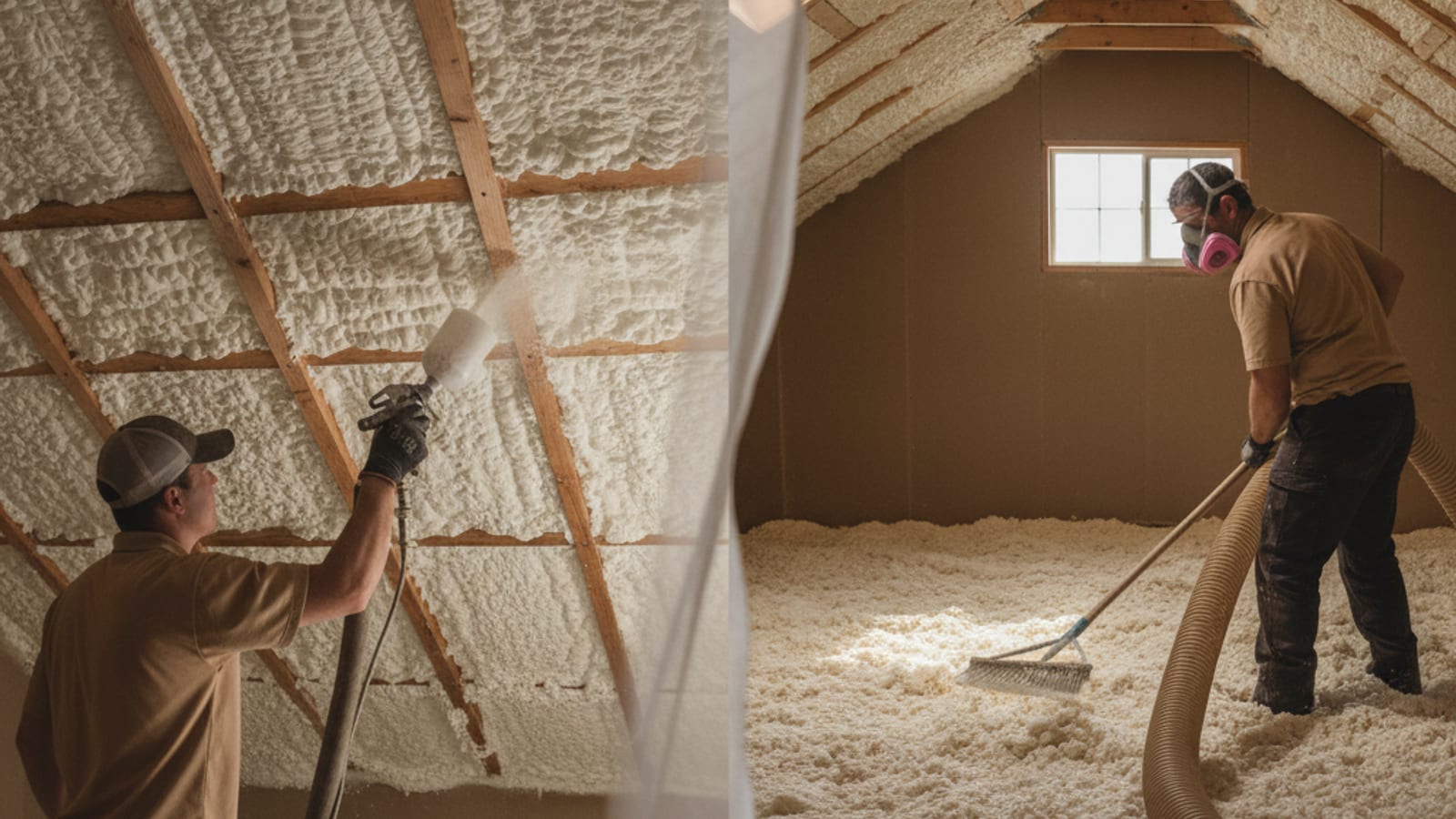
Spray foam costs more than blown-in cellulose. That’s the easy half of the answer. The harder half is which one is right for your specific attic — because they aren’t substitutes. They do different jobs and excel in different assemblies.
The short version
- Cellulose blown-in on the attic floor is the right answer for most San Diego attics. It’s about a third the cost of spray foam, performs to R-49 reliably, and resists air movement better than fiberglass.
- Spray foam at the roof deck is the right answer when you have a cathedral ceiling you can’t vent properly, when you’re conditioning the attic and bringing the HVAC inside the envelope, or when air-sealing matters more than R per dollar.
If you have a vented attic with the HVAC ducts on the attic floor and a flat ceiling below — that’s 80 percent of San Diego homes — cellulose wins on cost-per-comfort. If you have a vaulted ceiling, an unvented assembly, or a conditioned attic conversion — spray foam wins because cellulose can’t fill those assemblies.
Cost per R-value
This is the comparison that matters most:
- Blown-in cellulose: about $0.04 per R-value-square-foot installed. R-49 over 1,500 sq ft costs around $2,800 average.
- Open-cell spray foam: about $0.20 per R-value-square-foot installed. R-49 over 1,500 sq ft costs around $14,000 — and you don’t typically install open-cell on the floor; you install it at the roof deck.
- Closed-cell spray foam: about $0.18 per R-value-square-foot but at higher R per inch. R-49 in less depth costs around $11,000 over the same area.
Cellulose is roughly 4 to 5 times cheaper per unit of insulation. That math doesn’t lie.
Where spray foam earns its premium
Spray foam isn’t insulation alone — it’s insulation plus air barrier plus, in closed-cell, vapor retarder. When you need all three at once, the math changes:
Cathedral or vaulted ceilings. You can’t vent them properly. You can’t easily fill them with loose cellulose. Open-cell at the roof deck handles the assembly in one product.
Conditioned attic conversion. Moving the HVAC inside the envelope means the attic becomes part of the conditioned space. That requires insulation at the roof deck — closed-cell spray foam is the standard solution.
Rim joists in crawlspaces. A 6-inch-tall rim joist is fiddly to fill with batt and impossible to dense-pack. Two inches of closed-cell foam takes 30 minutes and stops the air leak that ate your floor heat.
Sound assemblies. Open-cell foam in interior walls quiets a room better than batts, in the same depth, with no thermal-bridging gaps.
Where cellulose earns its place
The list is longer and covers most homes:
Attic top-ups on existing R-13 or R-19. Just blow on top. No removal needed if the existing insulation is clean. Done in a half-day.
Empty walls in a 1960s tract home. Drill-and-fill dense-pack from interior or exterior. Two small holes per stud bay, patched and painted. R-13 to R-15 in walls that previously had nothing.
Empty open framing in a new addition. Loose-fill in attic, batts in walls. Standard, code-compliant, low-cost.
Dust and air-movement reduction. Cellulose at proper density resists air migration better than fiberglass. Combined with air-sealing of penetrations, it locks in performance.
A San Diego-specific consideration
Most of the county sits in California climate zones 7 (coastal) and 10 (inland). Title 24 requires vapor retarders only on the warm-in-winter side of the assembly — and in our climate, that side is the interior. Open-cell spray foam (vapor permeable) is fine. Closed-cell foam (vapor retarder) is also fine. Cellulose with no vapor retarder is fine in attics.
What this means in practice: the choice between spray foam and cellulose is rarely a vapor-control decision in San Diego. It’s almost always a cost-versus-air-seal decision.
A common scenario where both make sense
Your East County tract home has a vented attic, ducts on the attic floor, and original R-13 fiberglass that has settled to maybe R-9. You also have a bonus room over the garage with a low-pitch roof you can’t vent.
Right answer: cellulose blown to R-49 over the main attic floor, spray foam (closed-cell, R-30+) at the underside of the bonus-room roof deck. Two products, two assemblies, one quote. About $5,500 to $7,500 total.
That’s the kind of mix-and-match that lets the budget go further than picking one and applying it everywhere.
The decision framework
If your attic ceiling is flat and your HVAC is up there, blown-in cellulose plus air-sealing wins. Period.
If you have any vault, cathedral, conditioned attic, or rim joist in the scope, spray foam comes into the mix.
If someone is selling you spray foam everywhere as the only answer, get a second opinion. Not every assembly needs the most expensive product — and most San Diego attics don’t.